what’s the treatment process of MBR System for Wastewater Treatment?
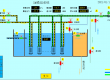
The MBR (Membrane Bioreactor) treatment process is a combination of biological degradation and MBR filtration, fundamentally replacing the traditional sedimentation tank. Its core workflow moves sequentially through Pre-treatment → Biological Treatment (Anaerobic/Anoxic/Aerobic) →MBR Separation →UV Disinfection .
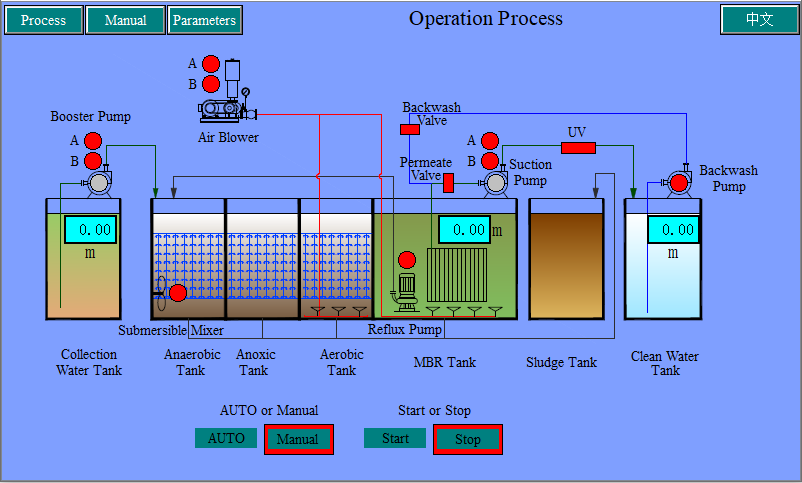
Here is a detailed breakdown of each stage in the process:
🧹 Stage 1: Pre-treatment (Physical Separation)
The primary goal here is to protect the downstream biological system and, most critically, the sensitive membrane modules from physical damage and clogging.
- Bar Screening: Wastewater first passes through a bar screen (or fine screen) to intercept large solid objects, plastics, weeds, and other debris that could damage pumps or membranes.
- Equalization Tank: are designed to buffer flows with variations in influent flow due to diurnal variation and wet weather events. Mixing is required in these basins to maintain solids in suspension, preventing deposition and equalizing load to the treatment plant. it’s an adjusting water tank, mix the input sewage, adjust the PH & make sure input water supplied (quality and quantity) stable.
- Specialized Pretreatment (Application-Dependent): For complex wastewater, additional steps are needed. For example, in oily wastewater treatment, a Dissolved Air Flotation (DAF) unit is essential. It uses coagulants and micro-bubbles to efficiently remove fats, oils, and grease (FOG) before they can foul the membranes.
🦠 Stage 2: Biological Treatment (Organic & Nutrient Removal)
This is the “bioreactor” part of the MBR, where microorganisms are used to consume organic pollutants and nutrients. The process often involves a sequence of tanks with different oxygen environments to achieve specific treatment goals, such as nitrogen and phosphorus removal.
- Anaerobic tank which the digestion is a sequence of processes by which microorganisms break down biodegradable material in the absence of oxygen, There are four key stages of anaerobic digestion involve hydrolysis, acidogenesis, acetogenesis and methanogenesis, and the main function is removed the Nitrogen and bacteria, that will help down the BOD.
- Aeration tank, the process involves air or oxygen being introduced into a mixture of screened, and primary treated sewage or industrial wastewater (wastewater) combined with organisms to develop a biological flock which reduces the organic content of the sewage. The main function is removing the nitrifying bacteria and phosphorus bacteria, and break down the COD& BOD
💧 Stage 3: Membrane Separation (Solid-Liquid Separation)
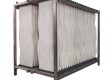
MBR (Hinada offer 3 years guarantee for MBR Membrane lifespan)
Membrane bioreactor (MBR) is the combination of a membrane process like microfiltration or ultrafiltration with a suspended growth bioreactor and is now widely used for municipal and industrial wastewater treatment. MBR separates the clean water from the wastewater, MBR membrane has very small pore sizes that are ranging from 0.04 – 0.4 microns. The MBR process combines triggered sludge treatment with the membrane for liquid-solid separation. When MBR can attain almost complete separation of the suspended solids & dramatic reduction in the contaminants.
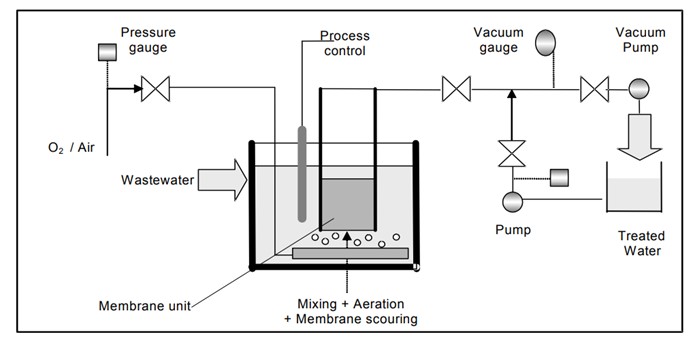
* MBR System operates at a low pressure/low energy
* High quality and stable effluent
* Lower Footprint space
* Installs quickly and easily operation
* Does not generate wastewater
✨ Stage 4: Post-Treatment & Disinfection
The high-quality permeate from the MBR is often ready for direct reuse, but final steps are taken for safety and specific reuse requirements.
- Disinfection: A small amount of disinfectant (such as sodium hypochlorite) is typically dosed into the permeate. This is a final safety barrier to prevent any potential bacterial regrowth in the storage tanks or the distribution network, ensuring the water is safe for its intended reuse purpose, such as irrigation or toilet flushing.
- after the MBR process to remove dissolved salts or trace recalcitrant organics.
In summary, the MBR process is a highly efficient and compact system. The biological stage acts as the “workhorse” that consumes the majority of the pollutants, while the membrane stage acts as a strict “gatekeeper” that guarantees a consistently clear, high-quality effluent.